
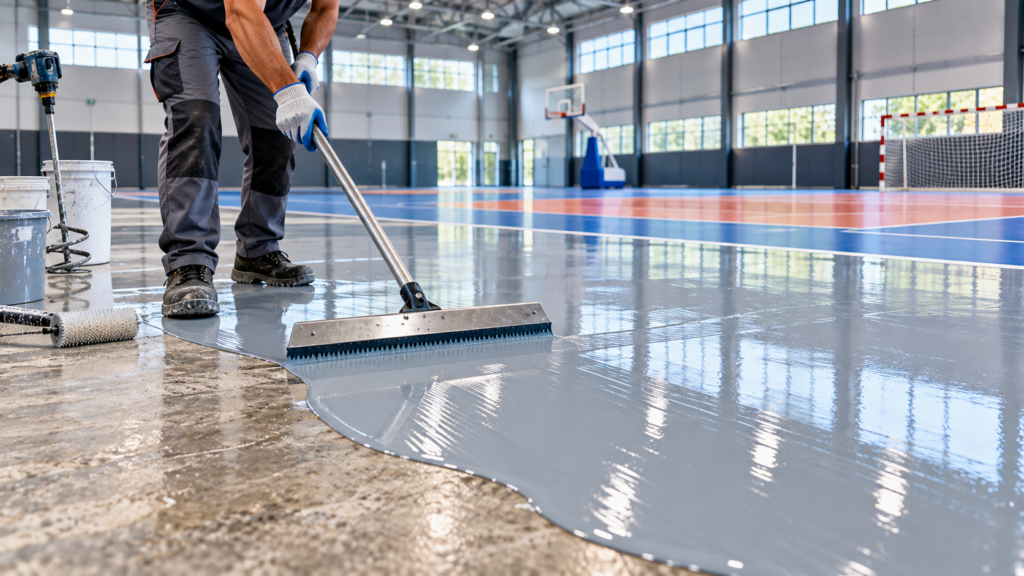
Ever wondered how some floors look perfectly smooth, glossy, and seamless, even across large industrial spaces? The secret often lies in self-leveling flooring systems! These specialised coatings spread across a properly prepared surface to create an even finish with minimal visible joints. From commercial buildings to manufacturing facilities, they offer a practical combination of appearance and performance. In this blog, how these systems work, their benefits, and how they differ from a self-leveling polyurethane system.
What Is Self-Leveling Epoxy Flooring?
Self-leveling epoxy flooring is a resin-based coating applied over a prepared concrete substrate. Once poured and spread, the material flows to create a smooth, continuous surface. After curing, it forms a hard, durable layer that can withstand regular foot traffic, equipment movement, and certain chemical exposures. Its seamless finish also makes cleaning easier, which is particularly useful in warehouses, laboratories, commercial kitchens, and other spaces where hygiene and maintenance matter.
How Does the Installation Process Work?
A reliable epoxy floor begins with proper preparation. Contractors first clean the concrete, remove contaminants, and mechanically prepare the surface to improve adhesion. Any cracks or defects are repaired before the primer and self-leveling epoxy are applied at the specified thickness. Installers then spread the material evenly and remove trapped air when required. Finally, the coating must cure according to the manufacturer’s instructions before the floor is ready for use.
What Are The Main Benefits?
One major advantage of self-leveling epoxy is its smooth, joint-free finish, which reduces places where dirt can collect. Its durability makes it suitable for many commercial and industrial environments. Depending on the formulation, it can also provide resistance to selected chemicals, abrasion, and stains. Decorative colours and finishes offer additional design flexibility. However, performance depends on the product specification, installation quality, substrate condition, and the demands of the intended environment.
How Does Epoxy Compare With Polyurethane Flooring?
Although both systems protect concrete floors, they have different performance characteristics. Epoxy generally provides a hard, durable surface with strong adhesion, while polyurethane coatings often offer greater flexibility and better resistance to certain forms of abrasion, weathering, and ultraviolet exposure. A Self-leveling Polyurethane system may therefore suit applications where flexibility or sunlight resistance is important. The best choice depends on operating conditions, chemical exposure, traffic levels, and the manufacturer’s technical recommendations.
Where Is Self-Leveling Epoxy Flooring Used?
Self-leveling epoxy is commonly used in warehouses, factories, hospitals, laboratories, showrooms, and commercial facilities. Its smooth finish supports routine cleaning, while its strength helps accommodate suitable levels of pedestrian and equipment traffic. Different formulations are designed for different environments, so not every epoxy coating suits every application. Before installation, assess moisture conditions, expected loads, slip resistance, chemical exposure, and cleaning requirements to select a system that meets the facility’s practical needs.
Wrapping It Up!
Self-leveling epoxy flooring combines a smooth appearance with durability and convenient maintenance, making it a useful solution for many commercial and industrial spaces. However, selecting the right coating requires more than focusing on appearance alone. Consider the environment, surface preparation, safety requirements, and expected performance before making a decision. Comparing epoxy with a self-leveling polyurethane system can also help you identify the most suitable option for your flooring project. Topfloor Sports Infra Pvt. Ltd. offers specialized polyurethane flooring materials and sports surface solutions to help customers explore suitable flooring systems for their project requirements.